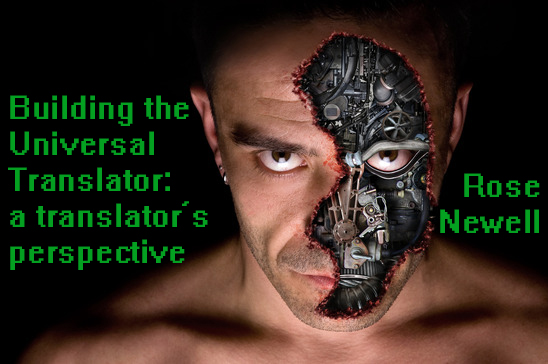
Science-fiction almost unanimously takes one vision of our future universe for granted: that all peoples shall be able to communicate with one another.
The technology enabling this is generally known as the “Universal Translator”: enabling interaction, profitable trade agreements, peaceful resolution of conflicts and cross-cultural understanding.
At present, translation and interpreting remain time-consuming tasks, requiring the dedicated attention of highly trained individuals, who each can only specialise in a limited combination of languages, or even fields. But even as a translator myself, if my job were to disappear overnight, I would indubitably rejoice at the utopian prospects the “Universal Translator” may realise: universal access to information, a level playing field for all! Égalité! But how close are we to achieving this wondrous goal, if it is even possible?
Machine translation has progressed a long way from simple dictionary-based methods pioneered in the 1950s. These have been replaced by context-based methods and advanced statistical tools, such as those used by Google Translate. These technologies promise to continually improve through increased integration of crowdsourcing principles, both imperceptibly in Google Translate, or obviously through Facebook or specialised platforms such as Transifex, which lists technology leaders such as Intel, Nokia, Firefox and redhat among their clients. However, the success of crowdsourced translation shows us this: translation technology only succeeds when it succeeds in making the process more human. Similarly, attempts by major translation companies such as Lionbridge or SDL to employ linguists as “post-editors” of texts lovingly crafted by machines have been met with great scepticism, and the common remark that the humans must pick up the slack where machines have failed.
Problems will always arise when profiteers seek to separate translation from its intrinsic human element. Indeed, machine translation will never succeed as long as there is no natural language understanding, that is to say, as long as the machine does not understand the intricacies of meaning, grammar, dialect, emphasis, errors and cultural references in a text, it will remain unable to produce reliable translations.
I do not rule out that the Universal Translator may one day come into being, but maintain that this development hinges on the simulation of all it means to be human: this machine must be able to interact with our society, understand jokes, think not just objectively but subjectively, creatively, and even sensitively to the character of its audience. It must think like a human.
I question that if we were to reach such an evolved level of human-machine interaction, whether inter-human interaction would remain our top priority? By comparison, research into communication with our fellow primates and earthlings has taken a long-standing back-burner following more exciting developments in space exploration, sending messages into outer space, and finally, artificial intelligence. When we finally develop a new “toy” capable of perfect machine translation of natural language, I doubt our desire for seamless cross-cultural interaction will remain as strong given the toy’s greater potential.
This article was originally written for the International Association of Professional Translators and Interpreters and was published under the following title: Building the Universal Translator: a challenge for machine translation, human-machine interaction and human nature

This post is very helpful. Glad you’ve shared it.
[…] in translation – sour cherries Lingo Woman’s useful resources for freelance translators #3 Building the Universal Translator: a translator’s perspective L’identité visuelle du traducteur en 4 questions essentielles Dolphin Talk: Will It Ever Be […]
[…] Science-fiction almost unanimously takes one vision of our future universe for granted: that all peoples shall be able to communicate with one another. The technology enabling this is generally known as the "Universal Translator": enabling interaction, profitable trade agreements, peaceful resolution of conflicts and cross-cultural understanding. The writer discusses how likely such a technology is. […]
In my opinion, if the universal translator will be realized then language translation may not be a problem. People from different races will understand each other easily.
Sometimes. I also think that if Universal Translator someday will be come. But if we think back again that the humans are not machines and humans have many limitations.
The hilarious – or perhaps tragic – part is that tech geeks all over the web are ranting on about how easy sites/apps etc can be ‘automatically’ translated, and yet, as we all know, the quality is, at best, dubious.
“research into communication with our fellow primates and earthlings has taken a long-standing back-burner following more exciting developments in space exploration, sending messages into outer space, and finally, artificial intelligence.”
I think this is a good point. The ubiquity of online translation tools that are not completely useless makes this subject a popular theme for discussion in translation circles, but the “strong AI” that would make reliable machine translation possible seems as far off as it ever was.
What’s more, such discussions distract attention from the really interesting questions such as: “What gets translated?” and “Who gets to do it?” Naturally an examination of these questions leads analysis of the discourses of power and the linguistic aquarium that is the nation state. There we would not subversives tinkering want!